-
Social Technology Lab
Focuses on digital healthcare research and development to improve healthcare access and outcomes in unreached communities.
-
Towards ZERO Unemployment
Create employment opportunities in the unreached communities by using the power of AI and youth.
-
3ZERO Leadership Challenge
Connect the Asian GenZ to imagine their world of 3ZEROs beyond SDGs.

Digital Innovation

Frugal Technologies

Social Business
Portable Health Clinic
A portable health clinic is a self-contained, mobile medical facility that can be transported to different locations to provide healthcare services to populations that may not have access to traditional medical facilities, such as those in rural or disaster-stricken areas. These clinics may be designed to offer a range of services, including primary care, dental care, diagnostic testing, and emergency medical treatment. Portable health clinics are often equipped with state-of-the-art medical equipment and staffed by trained medical professionals.
Visualization of Healthcare Data
Due to the ongoing digital transformation in healthcare, there is a shift towards digitizing healthcare data. However, digitalization alone is not sufficient for doctors to efficiently check patient history and make clinical decisions. Our research focuses on developing smart and efficient healthcare data visualization techniques to improve the performance of healthcare service delivery.
Personalization of Triage
Machine learning aids decision-making, but models are often opaque. Explainable AI aims to interpret
models and identify factors influencing decisions. This study analyzes health checkup data from a digital healthcare system called Portable Health Clinic. The research argues for personalized triage using explainable AI.
NCD Risk Prediction
In recent years, the prevalence of diabetes worldwide has been increasing significantly, and it is estimated that the number of diabetes patients will rise to 783 million (with a prevalence rate of 12.2% among individuals aged 20-79) by the year 2045. Diabetes risks complications and has far-reaching implications for society, finance, and healthcare.
Healthcare Information From Speech description
This research aims to develop a speech-based system that extracts structured healthcare information from doctor-patient conversations, focusing on challenges unique to low-resource languages. It investigates linguistics and technological barriers, designs, and end-to-end extraction architecture, and predictive clinical support, and new healthcare-specific linguistic resources to enhance accuracy in real clinical practice.
Speaker Diarization for Clinical Conversations Description
This research focuses on speaker diarization system tailored for doctor-patient conversations, especially with low-resource and accent-diverse clinical audio settings. It investigates issues such as overlapping speech, evaluation metrics and audio dynamics. This work designs an ASR enabled Diarization Pipeline that identifies speakers and their speech segments for downstream clinical information extraction, enabling EHR enrichment with conversational speech resources for healthcare applications.
Digitization of Analog Medical Report
Medical reports (Hematology, Clinical Chemistry, Microbiology, etc) are provided as paper documents in developing countries and stored as scanned images in EHRs in developed nations, hindering analysis. This research employs vision language models to classify, structure, and standardize scanned medical reports for integration into the Portable Health Clinic system effectively.
Non-Invasive AI-Driven Diagnostics
The research focuses on non-invasive platelet count estimation using optical sensing and machine-learning model. It is integrating biomedical signal acquisition, AI-based feature extraction, and clinical validation to create affordable, portable diagnostics tools. The goal is enabling accessible, painless hematological monitoring in diverse settings, improving early detection and expanding healthcare reach.
Cognitive-AI Healthcare Interfaces
The research analysis cognitive-load factors in healthcare interfaces and encodes validated HCI principles into generative AI design systems. Through context engineering, prompt optimization, and experimental evaluation, it aims to produce adaptive clinical UIs that significantly reduce medical input errors, improve practitioner efficiency, and support safer, more intuitive digital healthcare environments.
Predictive Digital Twins
The research develops a predictive Human Digital Twin framework to combat NCDs in youth. By fusing clinical, wearable, and lifestyle data with AI, it creates a personalized 3D avatar visualizing future health risks. This interactive “Future Me” empowers users with actionable insights, shifting healthcare from reactive treatment to proactive prevention.
Contextual Explainable Prescribing Research Description
This research builds explainable prescription recommendation systems for patients with polypharmacy by learning longitudinal patient-context representations from structured records and clinical text. It retrieves clinically similar cohorts, analyzes risks such as adverse drug events, and generates transparent, case-based medication suggestions that clinicians can inspect, trust, and adapt in practice.
Development of Revised ResNet-50 for Diabetic Retinopathy Detection
This research focuses on enhancing Diabetic Retinopathy detection by improving the ResNet-50 architecture with attention modules, refined small-lesion feature extraction, class-imbalance-aware loss functions, and medical-specific data augmentation, aiming to increase sensitivity and efficiency for real-world clinical deployment in diverse healthcare screening and diagnostic settings worldwide.deployment.
The research develops a predictive Human Digital Twin framework to combat NCDs in youth. By fusing clinical, wearable, and lifestyle data with AI, create a personalized 3D avatar visualizing future health risks. This interactive “Future Me” empowers users with actionable insights, shifting healthcare from reactive treatment to proactive prevention.
About SocialTech Lab
SocialTech Lab develops digital healthcare innovations-AI, digital twins, lifelong medical records, EHR standardization, and health risk prediction-to achieve universal health coverage and sustainable, data-driven healthcare systems globally.
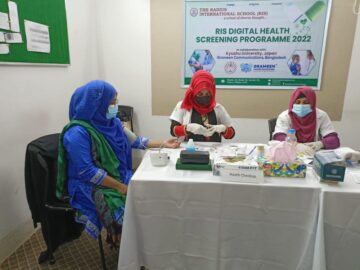
The provision of primary healthcare services in developing countries remains a significant challenge, particularly in low and middle-income countries. According to the World Health Organization
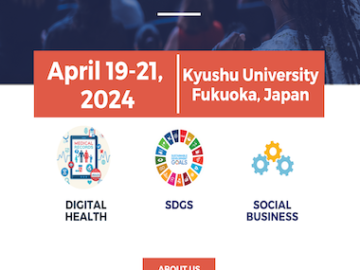
The 6th SocailTech Summit and International Conference on Healthcare SDGs & Social Business will be held on April 19-21, 2024 (online and virtual).
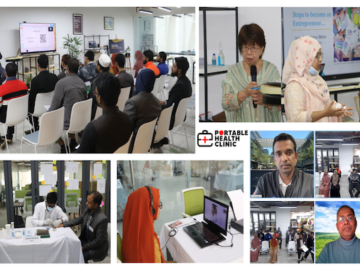
The 6th SocialTech Summit and Conference on Healthcare, SDGs, and Social Business
Two days long Micro Health Entrepreneurship (MHE) workshop held (hybrid) on 3-4 January 2023 at Grameen Telecom Bhaban, Mirpur-1, Dhaka, Bangladesh.